
Let’s Talk Poop: What Your Bowel Movements Say About Your Gut
Yes, we’re talking about poop.
As a gastroenterologist, I can tell you that your bowel movements give us a surprising amount of information about what is happening inside your digestive tract. How often you go, what your stool looks like, whether you have to strain, and whether you actually feel finished afterward all matter.
And one of the biggest misconceptions I hear?
“I poop every day, so I can’t be constipated.”
Not necessarily!
So… How Often Should You Poop?
There isn't one perfect number.
Some people naturally have several bowel movements a day, while others may go every other day and feel perfectly comfortable. Frequency is only one piece of the puzzle.
I’m much more interested in questions like:
Is your stool soft and formed?
Is it easy to pass?
Do you have to strain?
Are you sitting on the toilet forever?
Do you feel completely emptied afterward?
Are you passing little hard pellets?
Do you frequently feel bloated or backed up?
You can have a bowel movement every single day and still have constipation if you're straining, passing hard stool, or not emptying completely.
Meet the Bristol Stool Chart
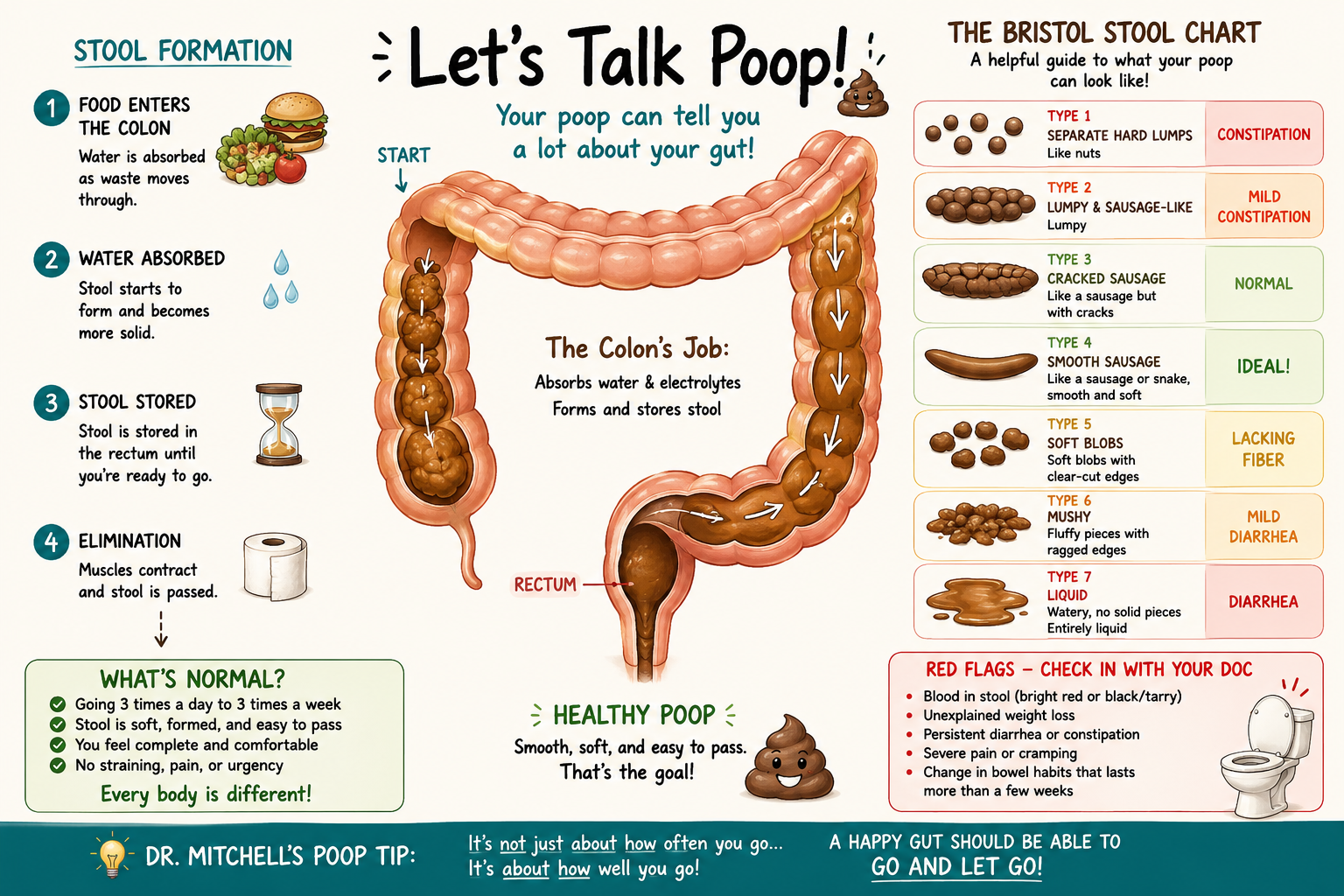
One of my favorite ways to talk about poop is the Bristol Stool Chart, which divides stool into seven types.
Types 1 and 2: Hard pellets or a hard, lumpy sausage. These often point toward constipation.
Types 3 and 4: Formed, sausage-shaped stools that are relatively smooth and easy to pass. This is generally the neighborhood we like to see!
Type 5: Soft blobs with defined edges. This can still be normal for some people, especially if it's easy to pass.
Types 6 and 7: Mushy to completely watery stool. When this happens frequently or persists, we start thinking about diarrhea and what may be driving it.
One unusual bowel movement isn't usually the important part. Patterns are what matter.
What Actually Happens Inside Your Colon?
Your colon isn't just a storage tube.
As digestive contents travel through the colon, water and electrolytes are absorbed and the remaining material gradually becomes stool. The colon then moves that stool toward the rectum, where it waits until your body is ready for a bowel movement.
If stool moves too slowly, the colon has more time to remove water. The stool can become harder, drier, and more difficult to pass.
If things move through too quickly, there may not be enough time to absorb water — and you may end up with loose or watery stool.
Your poop is essentially giving you clues about how your digestive system is moving.
The “I Went, But I’m Not Done” Problem
This is something I pay particular attention to.
You may poop every morning and still feel like there's more there. Maybe you go back to the bathroom multiple times. Maybe you strain. Maybe you never get that satisfying “Okay, I'm done!” feeling.
That sensation of incomplete evacuation can be important.
Constipation isn't simply about whether you poop. It's also about how well you poop.
In some people, the problem isn't just stool consistency. The muscles involved in having a bowel movement may not be coordinating correctly, or there may be another reason the rectum isn't emptying efficiently.
That's why simply telling everyone with constipation to “eat more fiber” isn't always the answer.
Your Toilet Can Tell You a Lot
Start paying attention before you flush.
Notice the shape, consistency, frequency, ease of passage, and whether you feel completely emptied.
You don't need to obsess over every bowel movement. But knowing what's normal for you makes it much easier to recognize when something has changed.
And some changes deserve medical attention — particularly blood in the stool, black or tarry stools, unexplained weight loss, significant abdominal pain, persistent diarrhea or constipation, or a new and lasting change in bowel habits.
Dr. Mitchell’s Poop Tip
It's not just about how often you go. It's about how well you go.
A good bowel movement should generally be soft, formed, comfortable to pass, and leave you feeling like the job is actually finished.
So yes, at GutWell we talk about poop — a lot.
Because sometimes what ends up in the toilet can tell us quite a bit about what's happening in your gut.
A happy gut should be able to go… and let go!